How far does a $10 AI subscription go?
A $10 AI subscription can be worth several times its fee — or not. How AI subscription credits work, and how to measure the value per dollar.
An AI subscription does not charge by the token — the small chunks of text a model reads and writes. You pay one monthly fee, and in return you get a wallet of usage for the month. Every model spends from that wallet at its own price. This guide is about the most common kind, where the included usage is a budget of dollars, and how far a small fee really goes.
Three kinds of AI subscription credits
- Dollar credit — the wallet is measured in dollars. You spend it at the models' normal per-token prices (their listed rates). This is the common case, and the rest of this guide.
- Token credit — the wallet is measured in the plan's own credits, and each model uses a different number of credits per token.
- Usage limited — the plan gives messages, tasks or a shared pool, with no token or credit amount published at all.
The three differ in how the included usage is counted. Everything below applies to dollar-credit plans, which cover most of the market.
How AI subscription credits work
A dollar-credit plan gives one budget of dollars for the month. That budget covers a different number of tokens per model, because each model has its own price. A cheap model gives many tokens; an expensive one gives few. The included amount for a model is its quota.
Do the model quotas add up?
No. The plan grants one wallet, not one per model. Each model's published quota is the same wallet seen at that model's rates, so adding the quotas together counts the plan several times. What matters is how much of the one wallet your mix spends.
How much can a $10 plan really give you?
Here is the part most plan pages leave out. The most a plan can cover is its biggest single-model quota — the dollars you get if you spend the whole budget on one model. Split the budget across models with smaller quotas and you cover less, even when the wallet is fully used. The mix decides.
The figure below shows the sample usage filling each model's quota. Each bar is the share of that model's quota the usage spends, shown as a percentage.
Now the same numbers as value per dollar — the usage covered divided by the monthly fee. Spending everything on the biggest quota reaches the best case. Spreading it across the mix covers less, and the plan never reaches its own cap.
How the wallet is spent
The plan spends the one wallet on the models in the order listed. Each model takes its share, and never more than what is left, so the running total stops at the full budget. The first example fits inside the wallet; the second runs past it, and the extra usage is billed at the normal per-token price.
Why the cost per token falls, then rises
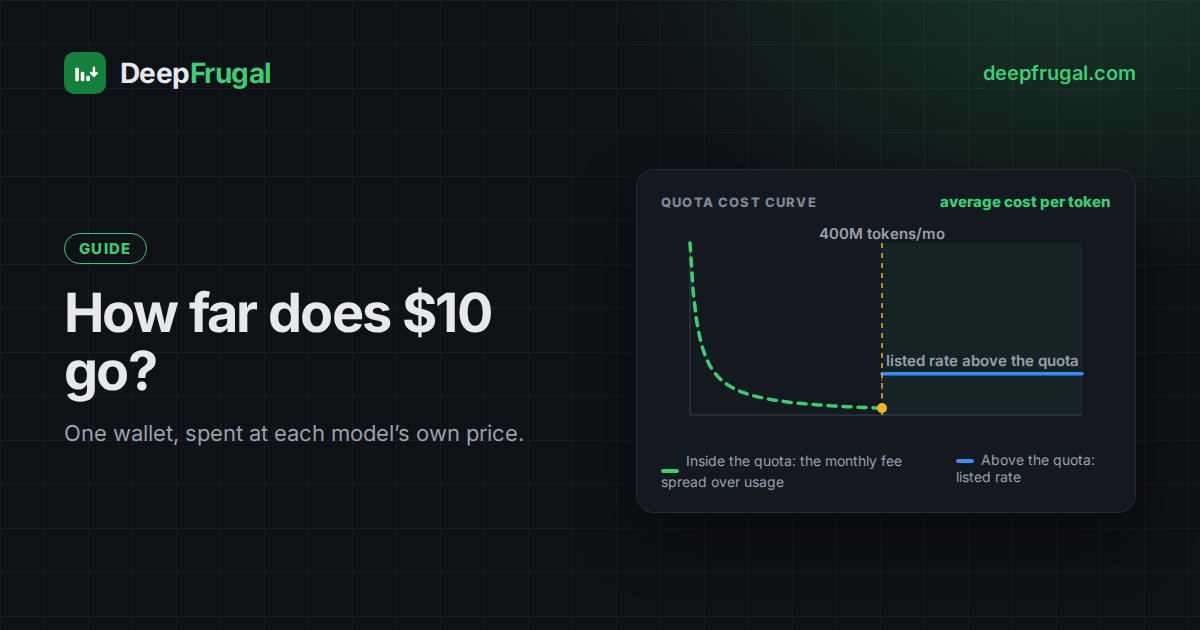
Read the curve by its average, not by the next token. Inside the quota the fixed fee spreads over more and more tokens, so the average falls. It reaches its lowest point at the quota limit. Above the limit the extra tokens are billed at the listed rate, so the average climbs back towards it.
AI subscription vs pay-as-you-go
Compare the curve with a flat pay-as-you-go rate — the price you pay when you buy tokens one by one. It crosses twice. The first crossing is where the subscription starts to beat the cheapest pay-as-you-go route. The second is where it loses again, because the extra usage above the quota costs more than paying per token. In between is the sweet spot: the plan covers everything and the average is still falling. That is where the fee gives the most value.
Above the quota the plan can still win — but only while the extra usage (the overflow) is billed at the listed rate, which is the default. Point the overflow at a cheaper route, or compare with a cheaper gateway, and the plan loses earlier.
Weekly and daily limits
Some plans also cap usage in a week or a day. These windows do not change the per-token prices. They change how fast you can spend the wallet, so they matter for usage that comes in short, heavy bursts, which would exhaust a window long before the month ends.
See it on a real plan
The figures above use sample numbers. Here is the same rule on a live plan: each bar is a model's monthly quota, drawn from the plan's one wallet. A model with higher rates draws the wallet down faster.
Browse every AI subscription plan in the live table, or learn how to find the best plan for your usage.
Run your numbers
Put your own mix against a plan. Pick a plan, add models and set the monthly usage. The calculator spends the one wallet in the order shown, marks the break-evens and states the cheaper side.
Not sure how to read it? How the break-even calculator works.
Plans, promos and prices change over time. Check the live table for current values.
Compare live AI subscription prices
Every widget links back to the live comparison table, where you can filter by plan, price and privacy, and sort the results. Four tools cover the decision from different angles:
- Break-even calculator — work out the usage where a monthly plan becomes cheaper than paying per token. Step-by-step tutorial.
- Plan comparison — put the same monthly usage into two plans and see which costs less. Step-by-step tutorial.
- Plan finder — rank every plan and pay-as-you-go gateway on your own usage. Step-by-step tutorial.
- Plan head-to-head — compare two plans model by model on value per dollar. Step-by-step tutorial.
Related reading: subscription vs pay-as-you-go walks through the calculator, and a head-to-head of two low-cost coding plans shows two real quotas side by side.
Summary
A dollar-credit subscription is one wallet, spent at the models' own prices. Its best case is the biggest single-model quota; a mixed workload usually covers less, so value per dollar is a ceiling, not a guarantee. Three thresholds decide the rest: where the average falls to the listed rate, where the plan starts to beat pay-as-you-go, and where it loses again. Estimate your monthly tokens, then check the live table or run the break-even calculator.
Frequently asked questions
What is an AI subscription?
A monthly fee that includes a set amount of model usage. Instead of paying per token, you pay once and spend the included usage during the month.
What are dollar credits?
The most common kind of included usage. The plan gives you a budget of dollars, and every model spends from that budget at its own listed price. Different models therefore use it at different speeds.
How many tokens does a $10 subscription give?
It depends on the models you run. The included amount is a budget of dollars, and each model spends it at its own rate, so a cheap model gives many tokens and an expensive one few.
Do the per-model quotas add up?
No. The plan grants one budget, not one per model. Each model's published quota is that same budget seen at the model's own rates, so adding them counts the plan several times.
Why do different models show different quotas?
Because their rates differ. A budget of dollars buys fewer tokens from an expensive model and more from a cheap one, so the same budget is restated as a smaller dollar quota for the dearer model.
What is value per dollar?
The usage the plan covers, in dollars, divided by the monthly fee. It is a best case, not a promise — it assumes you spend the whole budget on the model with the largest quota.
Can I always get the full value?
No. The best case needs the whole budget spent on the single model with the biggest quota. Share the budget across models with smaller quotas and you cover less, even if you use the whole budget.
Why does the cost per token fall, then rise?
The fee is fixed and spreads over more tokens as you use more, so the average falls to its lowest point at the quota limit. Above the limit extra tokens are billed at the listed rate, so the average climbs again.
When does a subscription beat paying per token?
In the middle of the curve. Use too little and the fee is not recovered; use too much and the extra usage costs more than buying tokens directly. The sweet spot is between those two points and the quota limit.
Is an AI subscription cheaper than an API?
It depends on how much you use. A subscription wins when your usage covers most of the included amount; paying per token wins when you use little, or when your usage swings a lot from month to month.
What happens if I use more than the quota?
The usage above the quota is billed separately, at the plan's overflow rate — usually the model's listed rate. The plan covers the quota; you pay for the rest.
Do unused AI subscription credits roll over?
Usually not. Most plans reset the included usage each month, and what you do not spend is gone. A few plans allow a capped rollover — check the plan's own terms.
Do weekly limits change the price?
No. Weekly and daily limits only cap how fast you can spend the budget. They matter for usage that comes in short, heavy bursts, where a window can throttle you before the month ends.
How do I check a real plan?
Estimate your monthly tokens, then open the break-even calculator and read where you land against the break-evens. It values a plan against the cheapest pay-as-you-go route. The step-by-step tutorial shows how to read it.