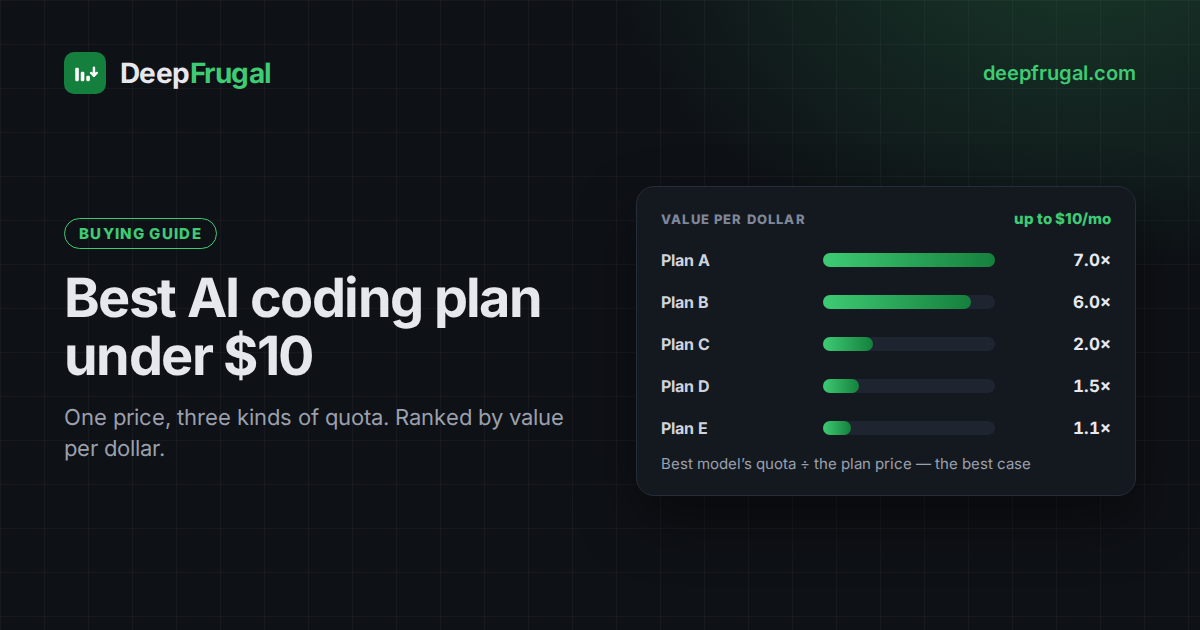
The same $10 buys three kinds of AI coding plan quota. Every plan at or below $10, ranked by the value its best model gives per dollar.
·20 min read·DeepFrugal
A monthly budget of $10 now buys a real coding plan, not a token allowance. But
the same $10 buys three different kinds of quota, and only some of them can be
ranked on value per dollar. This guide ranks every plan at or below $10 and shows
what each one actually grants.
The plans in this price band fall into three groups. A dollar-credit plan
gives one wallet of dollars, and each model spends it at its own listed rate. A
token-credit plan gives a wallet in the plan's own credits, and each model
spends a different number per token. A usage-limited plan gives access with a
cap that is never published as a token or dollar amount.
The ranking below lists every plan at or below $10 with two figures. Peak value
per dollar is the best case: the plan's largest single-model quota divided by
the fee, the whole wallet spent on one model. Avg value per dollar is the mean
across the plan's own models, the more typical case. A dollar-credit plan gives
one multiplier; a token-credit plan a range; a usage-limited plan publishes no
quota, so it carries no value.
Best value per dollar — up to $10/mo
Plan
Price
Quota type
What it grants
Peak value
Avg value
Command Code GOATCommand Code
$10.00
Dollar credit
$70.00
7×
3×
OpenCode GoOpenCode
$10.00
Dollar credit
$60.00
6×
3.9×
Ozore BasicOzore
$10.00
Dollar credit
$20.00
2×
2×
Copilot ProGitHub
$10.00
Dollar credit
$15.00
1.5×
1.5×
MiMo Token Plan LiteXiaomi MiMo
$5.28list $6.00
Token credit
4.1B credits
1.1×
1.1×
Google AI PlusGoogle AI
$4.99
Usage limited
2× baseline limits · 5h rolling + weekly cap
—
—
ChatGPT GoOpenAI
$8.00
Usage limited
Lightweight Codex usage; limits not published
—
—
SuperGrok LitexAI
$10.00
Usage limited
Shared weekly usage pool; no token count published
—
—
Peak value per dollar is the plan’s best model’s quota ÷ its price — the best case, where you spend the whole quota on one model. Average value per dollar is the mean across the plan’s own models, so a plan with many small quotas averages lower. A token-credit plan’s credits need not be proportional to its listed rates, so its value is a range; a usage-limited plan publishes no quota and shows no value.
The two figures answer different questions, and they can disagree. A plan can
hold the largest single-model quota and still average lower across its catalog,
because most of its models carry smaller quotas. Read the peak as the ceiling and
the average as the typical case.
The head-to-head below compares the two best plans in this band on their peaks:
each plan's most generous model, ranked by the value floor, the conservative
figure. The pair is picked from the table above, so it follows the ranking as
prices and promos change.
Plan head-to-head — Command Code GOAT vs OpenCode Go
Winner
Command Code GOAT+17% more usage per $
Peak value per subscription dollar, on each plan's most generous model. The two plans need not carry the same models. The winner is ranked by the value floor, the conservative figure.
Hy3 (shared peak)
7×6×
+17%
Command Code GOAT$10.00/mo · 7× · 4 models at peak
OpenCode Go$10.00/mo · 6× · 16 models at peak
▾ Models at the peak
A peak is the highest monthly allowance a plan offers, often on several models. These are all the models at each plan's peak; “shared” marks a model both plans carry at their peak.
OpenCode Go — 6× on 16: GLM 5.3 Flash, GLM-5.2 (shared), GLM-5.1, Kimi K2.7 Code, Kimi K2.6, LongCat-2.0, MiMo-V2.6-Flash, MiMo-V2.5, +8 more
The bar splits the two plans' peak value per dollar — each plan's most generous model's usage ÷ its subscription price: Command Code GOAT (Hy3) · OpenCode Go (Hy3). The winner is ranked by the value floor; a token-credit plan's ceiling can be higher.
Best case: it assumes you consume each plan's full peak-model allowance.
Peak value is a ceiling, not a promise. It assumes the whole wallet is spent on
the single model with the largest quota; a mixed workload covers less. How AI
credits work explains why the per-model
quotas are one wallet, not one each.
A dollar-credit plan grants a different quota per model. The bars below restate
the two best dollar-credit plans' one wallet at each model's own rate, biggest
first.
Monthly quota per model — Command Code GOAT
Qwen3.8 27B$70≈ 175M in
GPT-5.6 Sol$70≈ 14M in
Hy3$70≈ 500M in
GLM-5.2$70≈ 50M in
MiMo-V2.6-Flash$67≈ 479M in
DeepSeek V4.1 Flash$60≈ 400M in
DeepSeek V4 Flash$60≈ 400M in
Kimi K2.7 Code$60≈ 63M in
LongCat-2.0$50≈ 167M in
MiniMax M3$47≈ 157M in
GLM 5.3 Flash$40≈ 267M in
Gemini 3.8 Flash$40≈ 27M in
Gemini 3.7 Flash$40≈ 27M in
Grok 4.7$35≈ 18M in
Qwen3.7 Plus$33≈ 83M in
Qwen3.7 Max$33≈ 13M in
Qwen3.6 Plus$33≈ 66M in
MiMo-V2.5$30≈ 214M in
GPT-6 Luna$20≈ 200M in
MiMo-V2.6-Pro$20≈ 46M in
Step 5$20≈ 20M in
Qwen3.8 Omni Flash$20≈ 133M in
Muse Spark 1.3$20≈ 16M in
Muse Spark 1.3 Contributor$20≈ 200M in
Qwen3.8 Max$20≈ 10M in
Hy4$20≈ 24M in
Qwen3.8 Flash$20≈ 125M in
DeepSeek V4 Flash Vision$20≈ 133M in
GLM 5.3$20≈ 14M in
DeepSeek V4 Pro$20≈ 30M in
Grok 4.6$20≈ 10M in
Muse Spark 1.2$20≈ 16M in
Muse Spark 1.2 Contributor$20≈ 200M in
Inkling Small$20≈ 40M in
Qwen3.7 Flash$20≈ 667M in
Inkling$20≈ 20M in
Kimi K3$20≈ 7M in
GPT-5.6 Luna$20≈ 100M in
Grok 4.5$20≈ 10M in
Nemotron 3 Ultra$20≈ 33M in
Step 3.7 Flash$20≈ 100M in
MiMo-V2.5-Pro$20≈ 46M in
Step 3.5 Flash$20≈ 200M in
GLM-5.1$20≈ 14M in
MiniMax M2.7$20≈ 67M in
Qwen3.6 Max$20≈ 15M in
Kimi K2.6$20≈ 21M in
GLM 5$20≈ 20M in
Kimi K2.5$20≈ 33M in
MiniMax M2.5$20≈ 67M in
MiMo-V2.6-Pro-Ultraspeed$10≈ 2M in
Monthly quota per model, biggest first. A model with higher rates draws the budget down faster. Models without a published numeric quota are not listed.
Promo active · ends 2026-09-24
These figures use promotional rates or quotas. They change when the promo ends — confirm current pricing before you decide.
MiMo-V2.6-Flash — Boosted credits for 72 hours: $67 instead of $30 through September 24, 2026. Per-token rates are unchanged.
Grok 4.7 — Boosted credits while the 40% off deal runs: $35 instead of $20 through September 27, 2026.
DeepSeek V4.1 Flash (Off-Peak) — Boosted credits for 18 days: $60 instead of $40 through September 28, 2026. Per-token rates are unchanged.
DeepSeek V4.1 Flash (Peak) — Boosted credits for 18 days: $60 instead of $40 through September 28, 2026. Per-token rates are unchanged.
Monthly quota per model — OpenCode Go
GLM 5.3 Flash$60≈ 400M in
GLM-5.2$60≈ 43M in
GLM-5.1$60≈ 43M in
Kimi K2.7 Code$60≈ 63M in
Kimi K2.6$60≈ 63M in
LongCat-2.0$60≈ 200M in
MiMo-V2.6-Flash$60≈ 429M in
MiMo-V2.5$60≈ 429M in
MiniMax M3$60≈ 200M in
MiniMax M2.7$60≈ 200M in
Muse Spark 1.3 Contributor$60≈ 600M in
Muse Spark 1.2 Contributor$60≈ 600M in
Qwen3.7 Plus$60≈ 150M in
Qwen3.6 Plus$60≈ 120M in
DeepSeek V4.1 Flash$60≈ 400M in
Hy3$60≈ 429M in
Qwen3.8 Flash$30≈ 200M in
Qwen3.7 Max$30≈ 12M in
DeepSeek V4 Flash$30≈ 200M in
Hy4$30≈ 36M in
GLM 5.3$15≈ 11M in
Kimi K3$15≈ 5M in
MiMo-V2.6-Pro$15≈ 34M in
MiMo-V2.5-Pro$15≈ 34M in
Qwen3.8 Max$15≈ 8M in
DeepSeek V4 Pro$15≈ 23M in
DeepSeek V4 Flash Vision$15≈ 100M in
Grok 4.7$15≈ 8M in
Grok 4.6$15≈ 8M in
GPT-5.6 Luna$15≈ 75M in
Monthly quota per model, biggest first. A model with higher rates draws the budget down faster. Models without a published numeric quota are not listed.
Promo active · ends 2026-09-27
These figures use promotional rates or quotas. They change when the promo ends — confirm current pricing before you decide.
A model with higher rates draws the wallet down faster, so it shows a smaller
quota. The published quotas do not add up: they are the same budget seen at each
model's rates.
Not every plan in this band counts its wallet in dollars. A token-credit plan
counts it in the plan's own credits, and each model spends a different number per
token. The bars below restate the shared credit wallet at each model's rate; the
table after them gives the credit rate itself.
Monthly quota per model — MiMo Token Plan Lite
MiMo-V2.6-Pro4,100,000,000≈ 14M in
MiMo-V2.6-Flash4,100,000,000≈ 41M in
MiMo-V2.5-Pro4,100,000,000≈ 14M in
MiMo-V2.54,100,000,000≈ 41M in
The shared credit budget each model could consume alone, as the input tokens it buys at the model’s rate (bar and second line). The credits are the same for every model — one pool — so the bar compares how far each model’s rate stretches it; a model with higher credit rates draws the budget down faster.
Credit rate per 1M tokens — MiMo Token Plan Lite
Model
Input /1M
Cached read /1M
Output /1M
MiMo-V2.5
100M
2M
200M
MiMo-V2.5-Pro
300M
2.5M
600M
MiMo-V2.6-Flash
100M
2M
200M
MiMo-V2.6-Pro
300M
2.5M
600M
Credits one million tokens costs, by token type. The plan grants 4.1B credits a month for $5.28; divide the wallet by a multiplier to get the tokens it buys.
Because the credit rates need not track the listed prices, this plan's peak value
is a range rather than a point; its average collapses to one number. How token
credits work in AI plans covers
the mechanics.
Some cheap plans give access to strong models with a cap that is not published as
a token or dollar amount — a shared weekly pool, a rolling window, or per-model
message limits. They appear in the ranking without a peak or average value,
because there is no quota to divide by the fee. For those plans, judge them on
the models they offer and the shape of their limits, not on a value multiplier.
A subscription only beats paying per token if your usage covers enough of the
quota. Below the break-even you paid for usage you did not use; above the quota
the overflow is billed outside the plan. The calculator below values one plan
against the cheapest pay-as-you-go route and marks where the two cross.
Plan break-even — Command Code GOAT · Experimental
Cheaper
Subscriptionsave $19.29/month
You pay $14.90/month instead of $34.19 of usage.
Usage: 663M tokens · $50.35 at list rates · $34.19 cheapest pay-as-you-go.
Subscriptioncheaper$10.00/month
Quota used100%
Covered by the quota$45.45
Above the quota$4.90
Above the quota is paid outside the plan at the listed rate.
Monthly cost$14.90
Cheapest pay-as-you-go route
Real rates include the service fee; sales tax is not included.
GLM 5.3 Flash via Ozore API
DeepSeek V4.1 Flash via DeepSeek API
Monthly cost$34.19
Break-even: $10.00 of usage (≈ 132M tokens at this mix)
At your mix: subscription $10.00/mo · cheapest metered $34.19/mo · at list rates $50.35/mo — subscription is cheapest by $24.19/mo.
Plan break-even details
Average cost per token
Listed rate
Cheapest pay-as-you-go route
Quota limit
Cheaper than the cheapest
Quota usage break-even
Plan break-even / loses
Average at your mix
Hover the curve to read the values.
▾ How the graph is calculated
Inside the quota the average is the monthly commitment divided by the tokens used, so it falls as the mix scales up and reaches the mix's effective rate at the quota limit. Above the limit the pool is spent and the extra tokens are paid outside the plan at the overflow base chosen in Options — the model's listed rate (default), the cheapest pay-as-you-go rate found for it, or the cheaper of the two — so the average climbs towards that blended rate.
The pool is one shared budget: each model's allowance is that same pool restated at its rates — dollars for a dollar-credit plan, credits for a token-credit plan — and it is allocated in the model order shown, so a different order or blend moves the curve. A token type a model does not price still counts in the volume but adds no cost. The token axis is logarithmic, so a wide range of usage fits on one chart.
The pay-as-you-go line is the cheapest real rate per model (fee included; sales tax excluded) — an exact variant match when a pay-as-you-go gateway publishes that variant, otherwise the model's nearest published row — so it can combine more than one gateway. When that rate equals the plan's own listed rate the chart shows the listed line only.
The markers: the quota usage break-even is where the average meets the plan's list rate, so below it you pay more per token than list; the plan break-even is where the average starts to beat the cheaper of the two references; loses to the cheapest is where it stops doing so (it exists only when the overflow base is dearer than that reference); the your mix point is your stated usage, labelled with its monthly token volume, where the horizontal guide marks the mix's average cost per 1M, and the shaded band is where the subscription wins. With Promo prices off, every figure uses the pre-promo list rates and quotas, and the commitment reverts to the list subscription.
▾ How the plan quota is consumed
A subscription grants one monthly pool. The pool is allocated to the models in the order listed here: each model spends its usage divided by its quota, capped by what is left, so the total never exceeds 100%. Reorder the models to approximate your own pattern. Usage above a model's allowance, or beyond the pool, is paid outside the plan at the listed rate.
Model
Usage
Monthly quota
% of Quota
Pay as you go
GLM 5.3 Flash
$29.10
$40.00
72.8%
—
DeepSeek V4.1 Flash (Off-Peak)
$15.71
$60.00
26.2%
—
DeepSeek V4.1 Flash (Peak)
$5.54
$60.00
1.1%
$4.90
Total
$50.35
—
100%
$4.90
Budget used = 1.000 (100%) · Covered = $45.45 · Pay as you go = $4.90
▾ Effective rates (listed vs effective)
Model
Input /1M
Output /1M
Cached read /1M
GLM 5.3 Flash
$0.044$0.15
$0.148$0.5
$0.009$0.03
DeepSeek V4.1 Flash (Off-Peak)
$0.044$0.15
$0.178$0.6
$0.001$0.003
DeepSeek V4.1 Flash (Peak)
$0.089$0.3
$0.355$1.2
$0.002$0.006
Effective = listed × 0.296 at this usage · 100% of the plan budget used
Promo active · ends 2026-09-28
These figures use promotional rates or quotas. They change when the promo ends — confirm current pricing before you decide.
DeepSeek V4.1 Flash (Off-Peak) — Boosted credits for 18 days: $60 instead of $40 through September 28, 2026. Per-token rates are unchanged.
DeepSeek V4.1 Flash (Peak) — Boosted credits for 18 days: $60 instead of $40 through September 28, 2026. Per-token rates are unchanged.
Experimental. Confirm every figure against the provider's own pricing before you rely on it. DeepFrugal is not responsible for calculation errors.
Pick any plan in the band and put your own monthly usage against it. The
calculator spends the plan's one wallet in the order shown and states the cheaper
side.
Plan break-even — OpenCode Go · Experimental
Cheaper
Subscriptionsave $24.19/month
You pay $10.00/month instead of $34.19 of usage.
Usage: 663M tokens · $50.35 at list rates · $34.19 cheapest pay-as-you-go.
Subscriptioncheaper$10.00/month
Quota used84%
Covered by the quota$50.35
Above the quota$0.00
Monthly cost$10.00
Cheapest pay-as-you-go route
Real rates include the service fee; sales tax is not included.
GLM 5.3 Flash via Ozore API
DeepSeek V4.1 Flash via DeepSeek API
Monthly cost$34.19
Break-even: $10.00 of usage (≈ 132M tokens at this mix)
At your mix: subscription $10.00/mo · cheapest metered $34.19/mo · at list rates $50.35/mo — subscription is cheapest by $24.19/mo.
Plan break-even details
Average cost per token
Listed rate
Cheapest pay-as-you-go route
Quota limit
Cheaper than the cheapest
Quota usage break-even
Plan break-even / loses
Average at your mix
Hover the curve to read the values.
▾ How the graph is calculated
Inside the quota the average is the monthly commitment divided by the tokens used, so it falls as the mix scales up and reaches the mix's effective rate at the quota limit. Above the limit the pool is spent and the extra tokens are paid outside the plan at the overflow base chosen in Options — the model's listed rate (default), the cheapest pay-as-you-go rate found for it, or the cheaper of the two — so the average climbs towards that blended rate.
The pool is one shared budget: each model's allowance is that same pool restated at its rates — dollars for a dollar-credit plan, credits for a token-credit plan — and it is allocated in the model order shown, so a different order or blend moves the curve. A token type a model does not price still counts in the volume but adds no cost. The token axis is logarithmic, so a wide range of usage fits on one chart.
The pay-as-you-go line is the cheapest real rate per model (fee included; sales tax excluded) — an exact variant match when a pay-as-you-go gateway publishes that variant, otherwise the model's nearest published row — so it can combine more than one gateway. When that rate equals the plan's own listed rate the chart shows the listed line only.
The markers: the quota usage break-even is where the average meets the plan's list rate, so below it you pay more per token than list; the plan break-even is where the average starts to beat the cheaper of the two references; loses to the cheapest is where it stops doing so (it exists only when the overflow base is dearer than that reference); the your mix point is your stated usage, labelled with its monthly token volume, where the horizontal guide marks the mix's average cost per 1M, and the shaded band is where the subscription wins. With Promo prices off, every figure uses the pre-promo list rates and quotas, and the commitment reverts to the list subscription.
▾ How the plan quota is consumed
A subscription grants one monthly pool. The pool is allocated to the models in the order listed here: each model spends its usage divided by its quota, capped by what is left, so the total never exceeds 100%. Reorder the models to approximate your own pattern. Usage above a model's allowance, or beyond the pool, is paid outside the plan at the listed rate.
Model
Usage
Monthly quota
% of Quota
Pay as you go
GLM 5.3 Flash
$29.10
$60.00
48.5%
—
DeepSeek V4.1 Flash (Off-Peak)
$15.71
$60.00
26.2%
—
DeepSeek V4.1 Flash (Peak)
$5.54
$60.00
9.2%
—
Total
$50.35
—
84%
$0.00
Budget used = 0.839 (84%) · Covered = $50.35 · Pay as you go = $0.00
▾ Effective rates (listed vs effective)
Model
Input /1M
Output /1M
Cached read /1M
GLM 5.3 Flash
$0.03$0.15
$0.099$0.5
$0.006$0.03
DeepSeek V4.1 Flash (Off-Peak)
$0.03$0.15
$0.119$0.6
$0.001$0.003
DeepSeek V4.1 Flash (Peak)
$0.06$0.3
$0.238$1.2
$0.001$0.006
Effective = listed × 0.199 at this usage · 84% of the plan budget used
Promo active · ends 2026-09-27
These figures use promotional rates or quotas. They change when the promo ends — confirm current pricing before you decide.
The same $10 buys a dollar-credit wallet, a token-credit wallet or a usage-limited
tier, and only the first two can be ranked on value per dollar. The ranking above
gives each plan a peak value (the best case) and an average value (the typical
case), and the two can disagree — read both before you pick. Browse every AI
subscription plan in the live table, or read how token
credits work for the native-credit
case.
Plans, promos and prices change over time. Check the live table
for current values.
It depends on how you use it. A dollar-credit plan is ranked by the value its best model gives per dollar, a token-credit plan by how far its credit wallet stretches, and a usage-limited plan publishes no quota at all, so no single number ranks them together. The ranking above groups the plans by the kind of quota they grant.
It depends on the models you run. A dollar-credit plan gives a budget of dollars that each model spends at its own listed rate, so a cheap model stretches it further than an expensive one. A token-credit plan gives a wallet of the plan's own credits, and each model spends a different number per token. The ranking shows the best case for each plan.
# What are the three kinds of quota a cheap plan can give?
Dollar credit, token credit and usage limited. A dollar credit is a budget of dollars spent at listed rates. A token credit is the plan's own unit, spent at a per-model rate. A usage-limited plan gives messages, tasks or a shared pool with no published quota. How AI credits work covers the three.
# Why do some cheap plans show no value per dollar?
Because they publish no quota. A usage-limited plan gives access to models with a cap that is not published as a token or dollar amount, so there is nothing to divide by the fee. The ranking lists them without a value rather than inventing one.
# Is a dollar-credit or a token-credit plan better value?
They are counted differently, so the value per dollar is not directly comparable. A dollar-credit plan gives one multiplier; a token-credit plan gives a range, because its credits need not track its listed rates. How token credits work in AI plans explains the difference.
Only if your usage covers enough of the quota. A subscription wins in the middle of its cost curve: use too little and the fee is not recovered, use too much and the overflow costs more than buying tokens directly. The break-even calculator below shows where the crossing points fall for a plan.
Yes. Several plans sit below the cap, including a usage-limited tier and a token-credit tier. The ranking's price filter shows the plans at or below a smaller ceiling. Check the live table for current prices.
 Ozore Basic
 Copilot Pro
 MiMo Token Plan Lite
 Google AI Plus
 ChatGPT Go
 SuperGrok Lite
 Command Code GOAT+17% more usage per $